“The problem wasn’t the thoughts. It was that they had nowhere to go.”
It usually happened around 11pm. Not anxiety, exactly — I want to be specific about that, because it didn’t feel like dread. It felt more like the low hum of a fridge you’ve stopped noticing. Except it was in my head. The email I’d meant to send. The thing I’d promised myself I’d sort this week. The friend I’d been meaning to call back for three weeks now. Nothing dramatic. Just things that hadn’t closed.
I’d go to bed with them, wake up with them, and the day in between had this faint, low-level static running underneath everything.
For a long time I thought this was just how my brain worked. Some people sleep easily and some don’t. Some people can close the door on the day and some carry it into the night. I assumed I was the second kind.
I wasn’t. I just didn’t have a system for my brain.
Your brain is extraordinarily good at holding things open. It keeps unfinished tasks, unresolved conversations, and unmade decisions circulating in the background until you do something with them. Psychologists call these “open loops” — and the brain won’t release them until it believes they’ve been resolved, or at least acknowledged.
When you go to bed without closing those loops, your brain keeps them running. That’s not anxiety. That’s your brain doing its job, rather badly timed.
The fix is almost embarrassingly simple: a morning brain dump routine.
Every morning before the day properly starts, I write everything that’s sitting in my head. Tasks I’ve been avoiding. Things I’m quietly worried about. The slightly uncomfortable thing from yesterday I haven’t quite processed. Half-formed ideas. Things I need to remember. Everything. I don’t sort it or prioritise it or turn it into a structured list. I just get it out.
Then in the evening — ten minutes, usually while my tea cools — I do a short review. What got done. What didn’t. Anything still circling. I write it down and close the loop.
I haven’t had a 2am “I forgot something” panic in months.
Why this works
The morning brain dump works because it takes those open loops out of your brain’s holding system and puts them somewhere external. Once they’re on paper, your brain can let go. It doesn’t have to keep them circulating. You’ve told it: I see this, I’ve got it, you can relax.
The evening review works because it adds closure. The day isn’t just happening to you and then ending — you’re marking it, noticing it, tying it off. That act of deliberate closing changes how the next few hours feel.
Together, they take about fifteen minutes. Morning: five to ten minutes. Evening: five to ten. That’s the whole practice.
If you want to try a version of this yourself, the 7-Day Reset is a free seven-day email series with one small daily practice each morning — including the kind of morning and evening habits that tend to stick precisely because they’re this small. Sign up free at marshmuse.com.

What this actually looks like
I don’t use a special notebook. Whatever I have open. Some mornings it’s three lines. Some mornings it’s two pages. I don’t edit it or reread it straight away. The point isn’t a beautiful journal entry — it’s a cleared head.
The evening review is even lighter: what happened, what didn’t, what do I need to remember for tomorrow. I write it in the back of my journal, not the front. It doesn’t need to be a reflection. It just needs to happen.
The thing I didn’t expect was how much calmer the days themselves became. Because when everything is written down, nothing is lurking. I know what’s on the list. I know it’s achievable. There’s nothing in the background quietly pulling at my attention.
This is what nervous system regulation looks like in an ordinary life. Not a retreat, not a wellness app, not a significant overhaul. A notebook and fifteen minutes, split across the beginning and end of your day.
What is still circling — that you haven’t yet written down?
Three lines is enough. You’re not solving it tonight. You’re just telling your brain you’ve got it, so it can stop holding the door open.

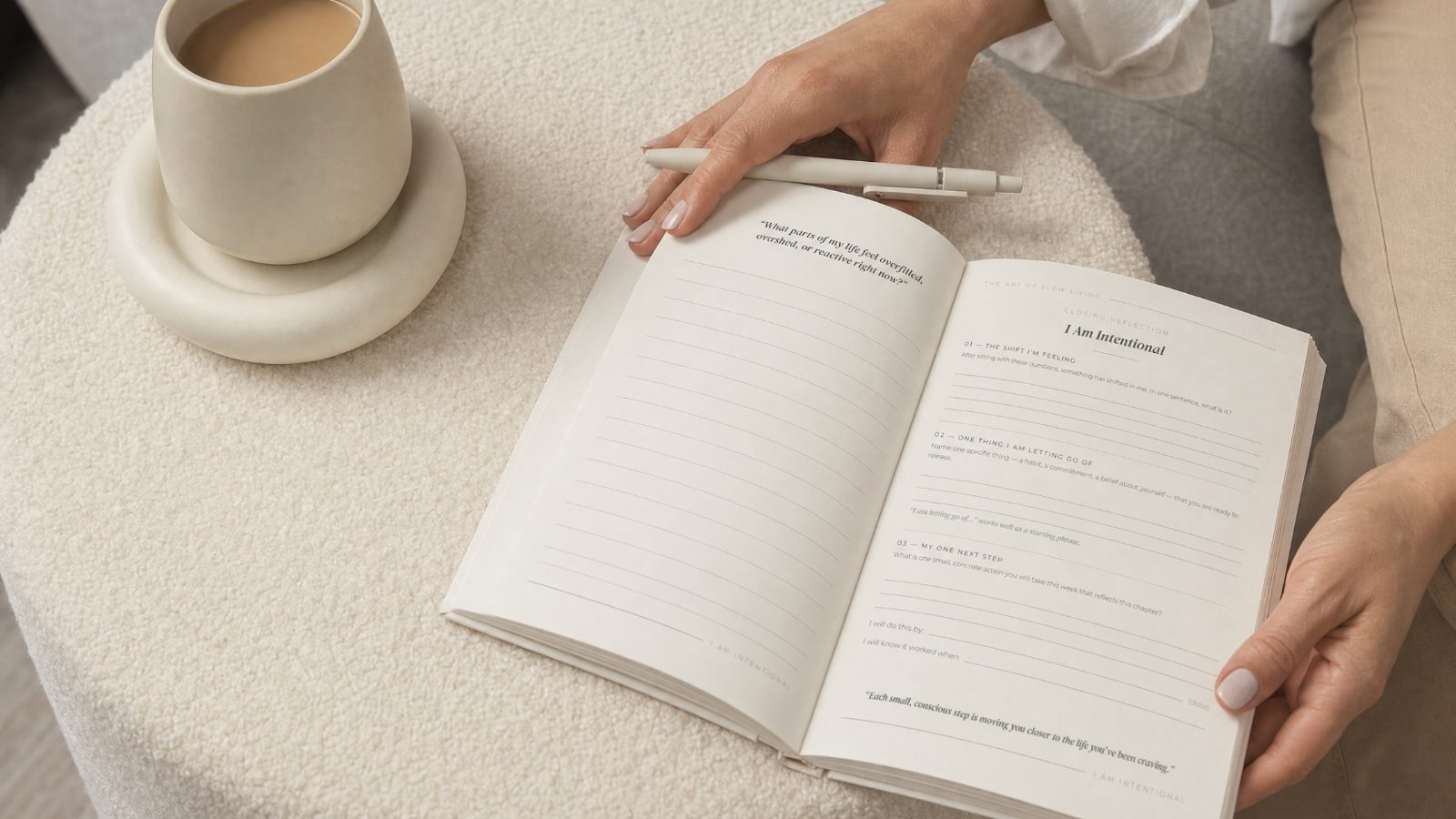
The Art of Slow Living journal has daily prompts built around exactly this kind of practice — short, structured, designed to open and close the day with a bit more intention. If you want something to work from, you can find it on Amazon.
The 7-Day Reset at marshmuse.com is free, takes five minutes a day, and is a good place to start if all of this sounds right but the blank page still feels daunting.
Marsh & Muse
A notebook and fifteen minutes, split across the beginning and end of your day.